
TLDR:
A capable, disciplined leader can work extraordinarily hard while his operating model quietly becomes less efficient.
Speed tells you how fast you are moving. Strategic velocity asks whether your effort is actually reaching what matters.
Rushing can fragment priorities and increase rework; strategic precision reduces friction and protects capacity across work and life.
The shift is Grinder → Precision Executor: remove friction and protect the energy and attention that make precise execution possible.
You may be the fastest person in your company.
You answer first. You decide first. When something stalls, you step in, and it moves. For years, that speed was your advantage. It is a large part of why the business exists at all.
Which makes this question uncomfortable:
What if the pace you’re demanding from everyone is part of what’s slowing the organization down?
How Speed Becomes Drag
Picture a familiar week…
On Monday, a founder sets three clear priorities for his team. By Tuesday afternoon, a client escalation has reshuffled them. At 9:40 that night, he sends a voice note with new direction. On Wednesday, he reopens a decision from last week because something about it no longer feels right. His project lead waits two days for an approval, then rushes to make the deadline. On Friday, the founder reviews the work, finds it isn’t what he pictured, and rewrites half of it himself.
He worked harder than anyone that week. He was also one of the main reasons the work moved slowly.
Nothing he did was lazy or careless. Every intervention felt responsible in the moment. But each one carried a cost the week didn’t show: a reset priority, a reopened decision, a stalled handoff, another round of corrections.
The pattern tends to run like this:
Urgency → reactive execution → rework and new dependencies → operational friction → lost capacity.
Not every interruption creates this chain. But when urgency repeatedly changes priorities, delays decisions and produces rework, the cost becomes difficult to ignore.
His ambition is not the problem. Neither is his sense of responsibility.
The problem is the friction those good qualities are being carried through.

Speed Is Not Velocity
Speed tells you how fast you are moving. Velocity adds direction. Strategic velocity asks whether your effort is actually reaching what matters.
More motion does not always mean more progress. Sometimes it means more friction.
Modern work already fragments attention. In Microsoft’s 2025 analysis of Microsoft 365 activity, the most-interrupted users (the top 20% by volume of pings) were interrupted by a meeting, email or notification roughly every two minutes. Separately, Microsoft reported that 57% of meetings were ad hoc calls without a calendar invite (Microsoft WorkLab, 2025).
Earlier research discussed by Gloria Mark at the University of California, Irvine found that interrupted work resumed the same day was picked back up an average of 23 minutes and 15 seconds later, often after people had moved through other tasks in between (Gallup Business Journal, 2006). That is time until returning to the original task—not 23 minutes of lost productivity.
The studies measured different things in different settings.
Taken together, they raise a useful question:
What happens when demands arrive faster than people can return to the priorities those demands displaced?
The day can be filled with responses while important work loses its continuity.
A leader operating in constant urgency doesn’t just experience that environment. He adds to it for everyone around him.
A fragmented system does not become cleaner because the operator moves faster.
It becomes cleaner when the operator restores direction, sequence and priority.
Velocity is not how much force you apply. It is how much force reaches the right target.
Over time, the lost force compounds into what I call Systems Debt: the accumulated cost of operating rules, habits and structures you have outgrown. Like financial debt, it rarely announces itself. It shows up as interest: more follow-up, more correction, more effort for the same result.

Why Year-End Raises the Stakes
For many leaders, the final stretch of the year brings unfinished objectives, deadlines, financial decisions and next-year planning.
Then personal responsibilities can arrive alongside them: family gatherings, travel arrangements, household obligations, holiday expectations or simply more people needing your attention. These demands vary by person, culture and circumstance, but they rarely come with an extra supply of time or energy.
And the business is only one place where capacity is being spent. You can streamline the team calendar and still carry a crowded personal calendar, an overactive mind and a tired body.
Slowing down has to become more than an execution tactic. It has to become a capacity decision.
The pressure isn’t only professional, either. In a 2023 survey of 1,000 adults conducted for the American Heart Association, 63% said the holiday season was more stressful than tax season (American Heart Association). That survey describes the general U.S. public, not executives specifically. For leaders already balancing substantial responsibilities, seasonal demands adds another layer of pressure.
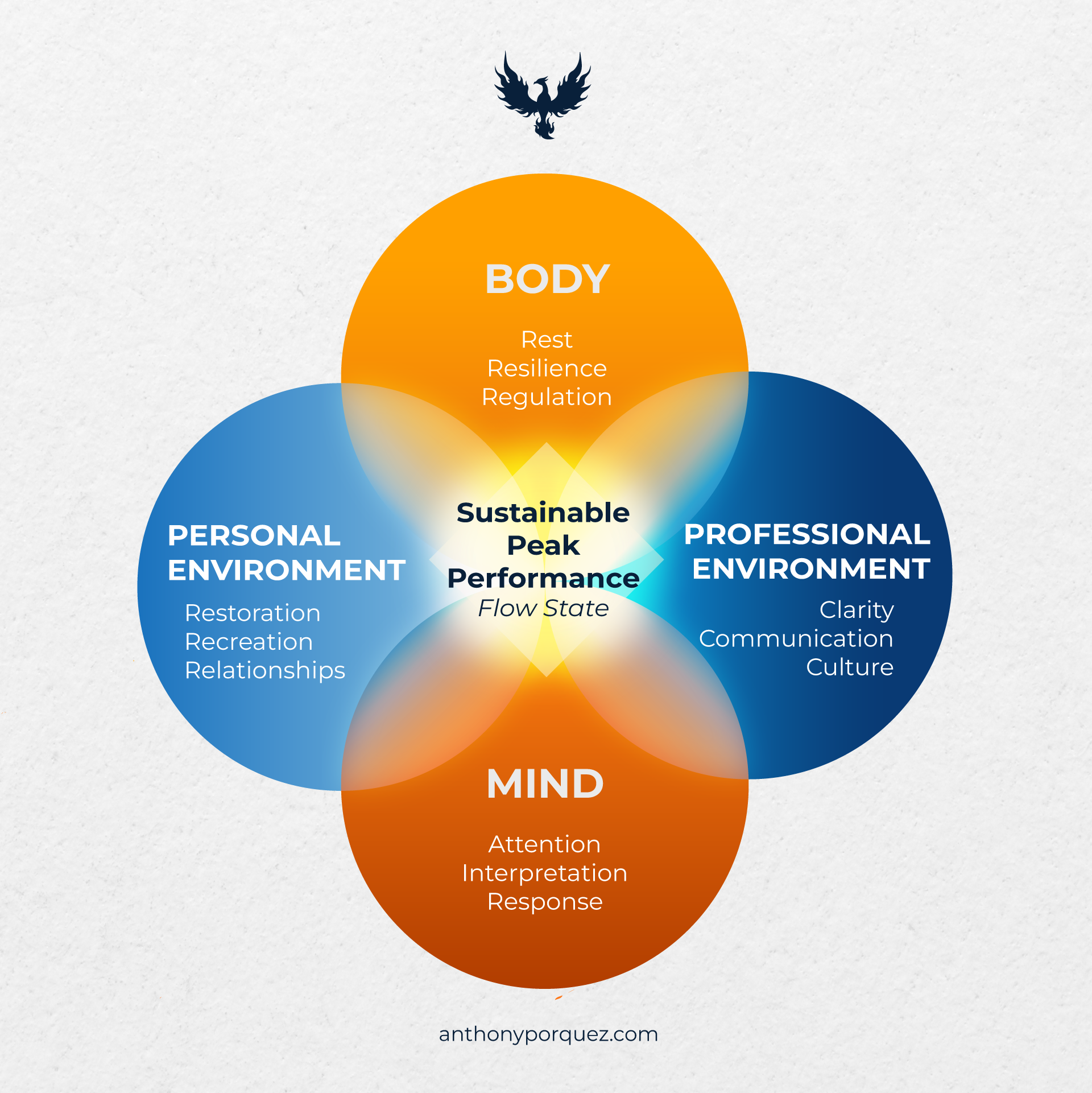
Four Elements. One Capacity to Protect.
The Phoenix System looks at the conditions a man is carrying through four connected elements.
Professional / Fire: includes projects, decisions, leadership and income demands.
Personal / Earth: includes relationships, family responsibilities, environment and the commitments outside work.
Mind / Air: includes attention, emotional load and the ability to think clearly.
Body / Water: includes sleep, movement, nourishment and the physical resources that sustain effort.
You can organize your professional responsibilities and still be overwhelmed by everything happening outside work. You can manage both calendars and still neglect the mind and body carrying those demands.
That is why creating capacity requires looking at the whole system—not just the number of tasks on your schedule.
Fatigue Makes Execution Less Precise
Year-end doesn’t only demand effort. It demands judgment.
What needs to be completed? What can wait? Which decision actually matters? Which request is loud but not important? What requires your attention, and what only wants it?
Those questions require precision, and precision is exactly what fatigue erodes. According to CDC/NIOSH, fatigue can reduce attention and concentration, limit short-term memory, slow reaction time and impair judgment (CDC/NIOSH).
That doesn’t diagnose any individual leader.
It does explain why the moment you most need clean judgment can be the moment it is hardest to access.
When precision drops, speed becomes expensive.
You miss details. You make reactive decisions. You over-answer and under-delegate. You spend tomorrow cleaning up what urgency created today.
That is not strategic velocity. That is a system leaking force.
This is why slowing down is not softness. It is precision management.

The Slingshot Principle
A slingshot doesn’t launch by being pushed forward. It launches by pulling back.
That is the part high performers often resist. They want the forward motion without the pause that aims it.
Year-end offers a reason to pull back strategically—not from responsibility, but from unnecessary friction. Reconfirm what matters, stop reopening settled priorities, and decide which commitments need full force now and which can be approached differently.
A deliberate pause can prevent avoidable corrections at work. It can also create room to meet personal responsibilities without consuming every reserve of attention and energy. Pullback is not abandonment; it is preparation to move cleanly.
The man who refuses to pull back eventually mistakes strain for commitment.
Slowing down is not the opposite of velocity.
Sometimes it is the condition that makes velocity possible.

Grinder → Precision Executor
The Grinder asks: How do I keep everything moving? How do I push through every competing demand? How do I avoid slowing down?
The Precision Executor asks: What matters most now? What friction can I remove? Where must I protect the energy and attention that allow me to follow through?
The Grinder worships motion. The Precision Executor protects clean force.
This is not about becoming passive. It is about becoming accurate.
By this point in the year, the question is no longer whether you can apply more force. You already know how to do that.
The question is whether the force is still clean.
The problem with speed: clarity of Perception, Accuracy of Response
Before You Push Harder: Three Questions
1. Where is friction consuming effort? Identify one important outcome that is taking disproportionate effort, follow-up or correction to move.
2. What is producing that friction? Look at the operating conditions around it: shifting priorities, reopened decisions, unclear delegation, repeated corrections, fragmented attention, or a rule you are still following because it once worked.
3. What one change would reduce that friction without lowering your standards? Not indiscriminate subtraction. One precise decision: a priority held for a full week, a decision made once, an approval delegated, a handoff clarified.

Protect the Space You Create
The next decision is what to do with the capacity you reclaim.
If delegating an approval gives you an hour back, don’t automatically fill it with another meeting.
Protect some of that space for what supports your energy and clarity. Maybe that’s movement, time in nature, proper nourishment, quality sleep, or simply a period without constant decisions and demands.
Different men restore capacity differently.
The point is to identify what genuinely supports your mind and body—and make room for it before the calendar fills.
These are not rewards you earn after everything is finished. They are part of the capacity required to carry your responsibilities well.
Sometimes the most productive decision is to stop adding demands and protect the conditions that make precise action possible.

WRap Up: One Small Step Toward Greater Clarity
Recognizing where your capacity is being consumed is a first step.
Understanding the operating patterns behind it can help you decide what to change next.
Start small. You do not need another complicated system to begin.
The free 3-Day Burnout Clarity Mini-Course offers a manageable next step.
Sign up to receive one short video by email each day for three days, introducing questions and perspectives that can help you examine patterns affecting your energy and capacity. You can begin with one insight and one deliberate adjustment. Protect your peace this November.