TLDR:
May is a stress test: by this point in the year, high performers assume they “should be fine,” so they compensate instead of recalibrating—creating maintenance debt.
Mental health is maintenance, not crisis response: treat it like infrastructure that prevents breakdown, not something you address only when you’re already on fire.
Run the May Mental Maintenance Audit across the Phoenix elements: Fire (work system), Air (mind), Water (body), Earth (personal space) to find your biggest leak.
Fix one leak with one standard: load engineering at work, an operational closeout to stop cognitive spillover, a 7-day capacity anchor, and a recovery + support cue at home.
Take action immediately: start the free 3-Day Capacity Audit to identify your #1 leak and lock in one maintenance standard this week.
If May feels heavier, it’s not weakness. It’s maintenance debt.

May is when the “I should be fine by now” script becomes dangerous.
By May, Q1 is done. The year is in motion. Everyone expects momentum.
And the unspoken rule shows up:
You should be back in rhythm by now.
So if your energy is still off in May, most high-performing men don’t recalibrate.
They compensate.
More hours. More urgency. More control. Less margin.
That isn’t discipline. That’s maintenance debt.
And the worst part is the story you tell yourself while it’s happening:
If I’m still not at full capacity, something must be wrong with me.
No. What’s wrong is the operating model.

May is Mental Health Month…
and Mental Health America’s 2026 theme is “More Good Days, Together.” That’s not a crisis slogan. It’s a maintenance slogan.
It’s about building a system that produces good days more often—without waiting for a breakdown first.
Mental Health Month: https://mhanational.org/mental-health-month
2026 theme announcement: https://mhanational.org/news/more-good-days-together-2026-theme-announcement/

SECTION 1: Mental health isn’t a crisis category. It’s maintenance.
High performers treat mental health like a fire extinguisher: something you reach for only when the room is already on fire.
But that’s not how sustainable output is built.
You don’t maintain your finances only when you’re broke.
You don’t maintain your health only when you’re sick.
You don’t maintain your business only when the numbers crash.
Maintenance is what prevents crisis.
This isn’t “self-help.” It’s systems reality.
Gallup’s global data shows how widespread stress is: 40% of employees report experiencing stress “a lot” the previous day. If that’s the baseline environment, then “push harder” isn’t a strategy—it’s a leak you’re normalizing.
Source: https://www.gallup.com/workplace/697904/state-of-the-global-workplace-global-data.aspx
WHO reinforces the same point from a workplace design angle: work can protect mental health, or it can worsen it—depending on conditions—and work-related mental health conditions are preventable.
WHO workplace guidance: https://www.who.int/teams/mental-health-and-substance-use/promotion-prevention/mental-health-in-the-workplace
WHO fact sheet: https://www.who.int/news-room/fact-sheets/detail/mental-health-at-work
So if your current model is “I’ll just power through May,” here’s what’s actually happening:
You’re running performance on a system with leaks.
And the longer you run it that way, the more it costs to keep output stable.
That’s why this article isn’t about motivation.
It’s about a maintenance audit—four places where high-performing men quietly lose capacity in May.
SECTION 2: The May Mental Maintenance Audit (4 leaks)
If you want more good days, stop chasing motivation. Fix the leaks.
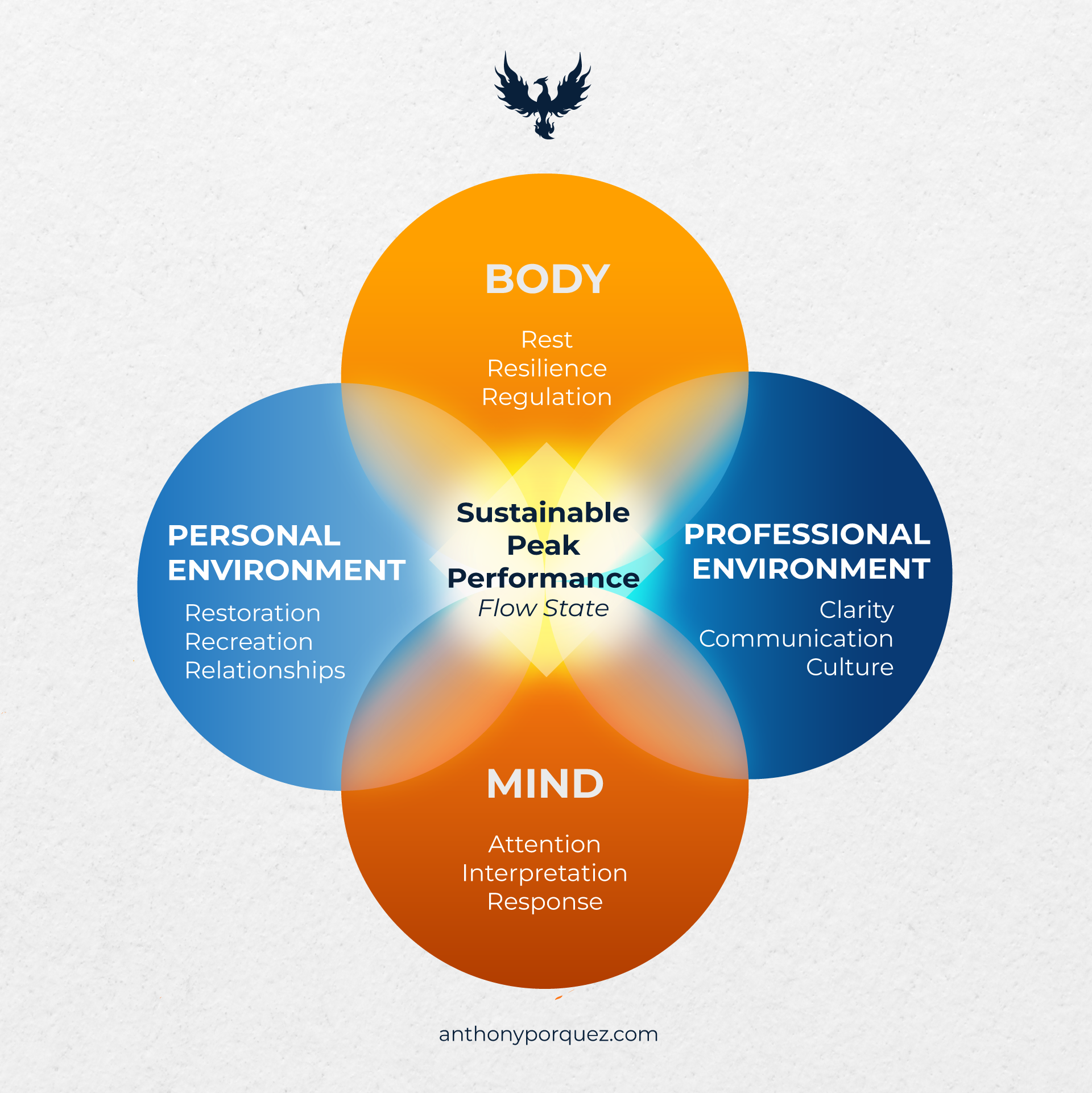
This audit uses the Phoenix elements because they map to how performance actually works:
That starts with three things: boundary, environment, and ritual.
Water (Body) — your baseline capacity and resilience
Air (Mind) — your cognitive load and regulation capacity
Earth (Personal Space) — your recovery environment and support structure
Fire (Professional Space) — your work system and its stress load
Run the audit like a founder, not like a patient. You’re not diagnosing emotions. You’re identifying system failures.
Leak #1 — Earth (Personal Space): Your environment isn’t a recovery system—and neither is your support
This is the leak high performers ignore the longest because it doesn’t feel “productive.”
But it controls everything.
If your home environment keeps you in low-grade stress—noise, clutter, screens in bed, no downshift cues—your nervous system never fully exits “work mode.”
And if your support system is whatever’s left over, you’re running pressure solo. That’s not strength. That’s design failure.
May gives you a clean cultural moment to address this: International Day of Families (May 15). Use it as a prompt to audit roles, strain, and support design.
Source: https://www.un.org/en/observances/international-day-of-families
Maintenance standards (choose one primary + one secondary):
Primary (environment):
Install one recovery cue:
phone out of bed, or
one wind-down cue repeated nightly (same cue, same order)
Secondary (support):
One pressure-release conversation this week.
A deliberate check-in with one person that reduces isolation and increases clarity.
You don’t need more advice. You need more load-sharing.
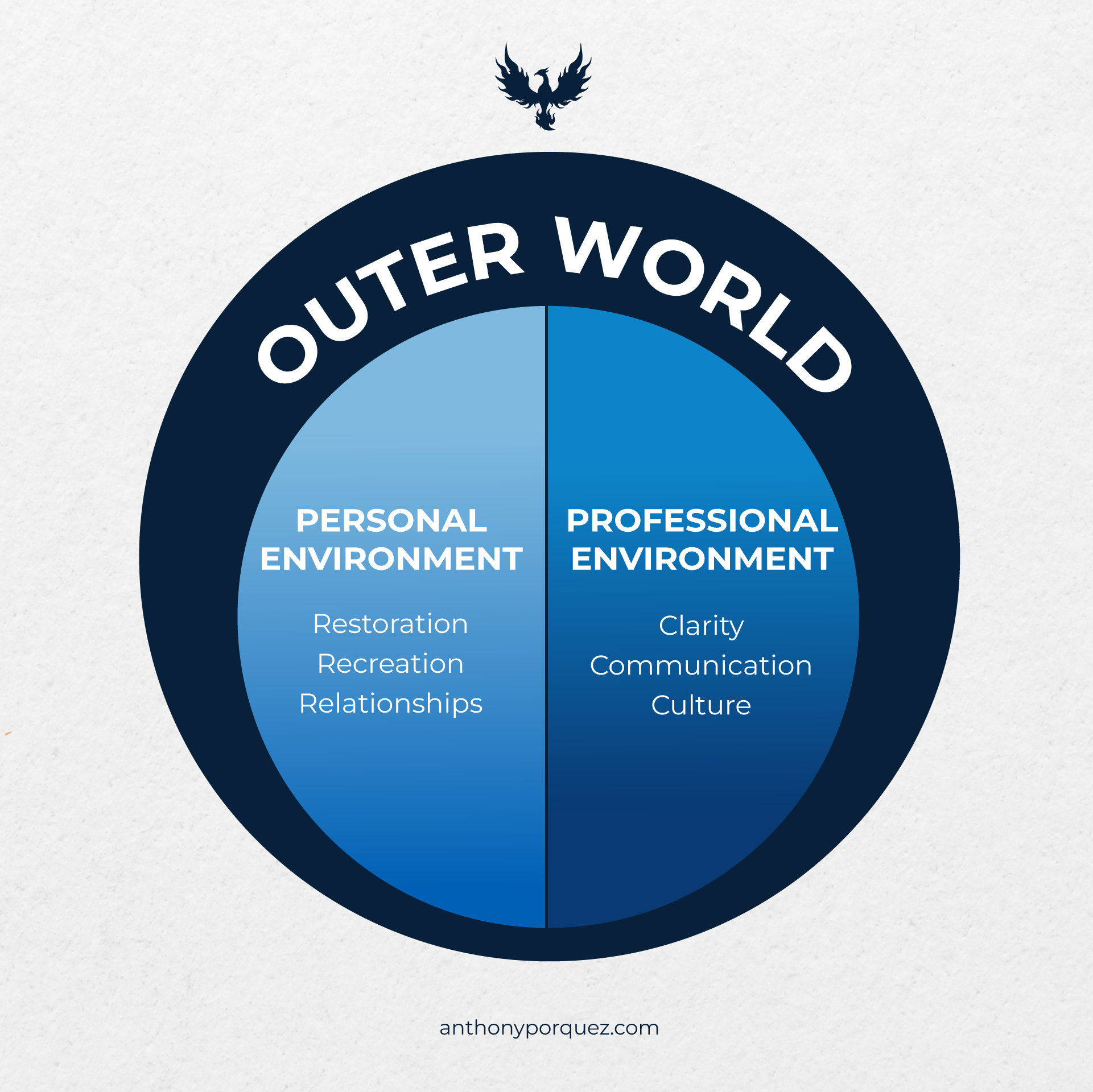
Leak #2 — Fire (Professional Space): Preventable work-system stress
This is the most common leak in May, and it hides in plain sight.
In most companies, this isn’t a personal issue. It’s built into the system before you arrived.
The work system generates chronic stress through design:
meeting density
constant availability
urgency culture
zero buffer
recovery treated like “optional”
Most men misread this as a personal resilience issue. It’s not.
WHO’s position is clear: workplace mental health outcomes are shaped by conditions—and those conditions can be improved.
And WHO’s definition of burnout makes the mechanism explicit: it’s linked to chronic workplace stress that has not been successfully managed, with exhaustion, cynicism/mental distance, and reduced efficacy.
Maintenance standard (choose one, install it this week):
Remove one preventable stressor from your work system.
Pick one:
No meetings in the first hour, two days this week
Two weeknights with a hard stop time
One closed-door deep work block that never gets booked over
Don’t call it “boundaries.” Call it load engineering. You’re reducing preventable strain so the machine can run.
Leak #3 — Water (Body): Capacity debt (you can still function, but you’re paying interest)
This leak is dangerous because it doesn’t look like failure. It looks like “still hitting your numbers.”
You’re still performing—but you’re borrowing against next week to do it.
You’re converting future capacity into today’s output. And the interest shows up fast.
Capacity debt looks like:
slower decisions
lower tolerance for friction
impulsive choices
reliance on stimulation to stay sharp
emotional range narrowing (everything becomes irritation or numbness)
You can still perform in this state. You just pay for it with volatility.
If you want one clean, non-hype reference: NIH/NHLBI notes that sleep deficiency can impair decision-making, problem-solving, emotional control, and coping with change. (Not a sleep sermon—just a capacity reality.)
Source: https://www.nhlbi.nih.gov/health/sleep-deprivation/health-effects
Maintenance standard (choose one for 7 days):
Pick one capacity anchor:
consistent wake time, or
consistent shutdown time
The goal is not perfection. The goal is to stop your baseline from drifting.
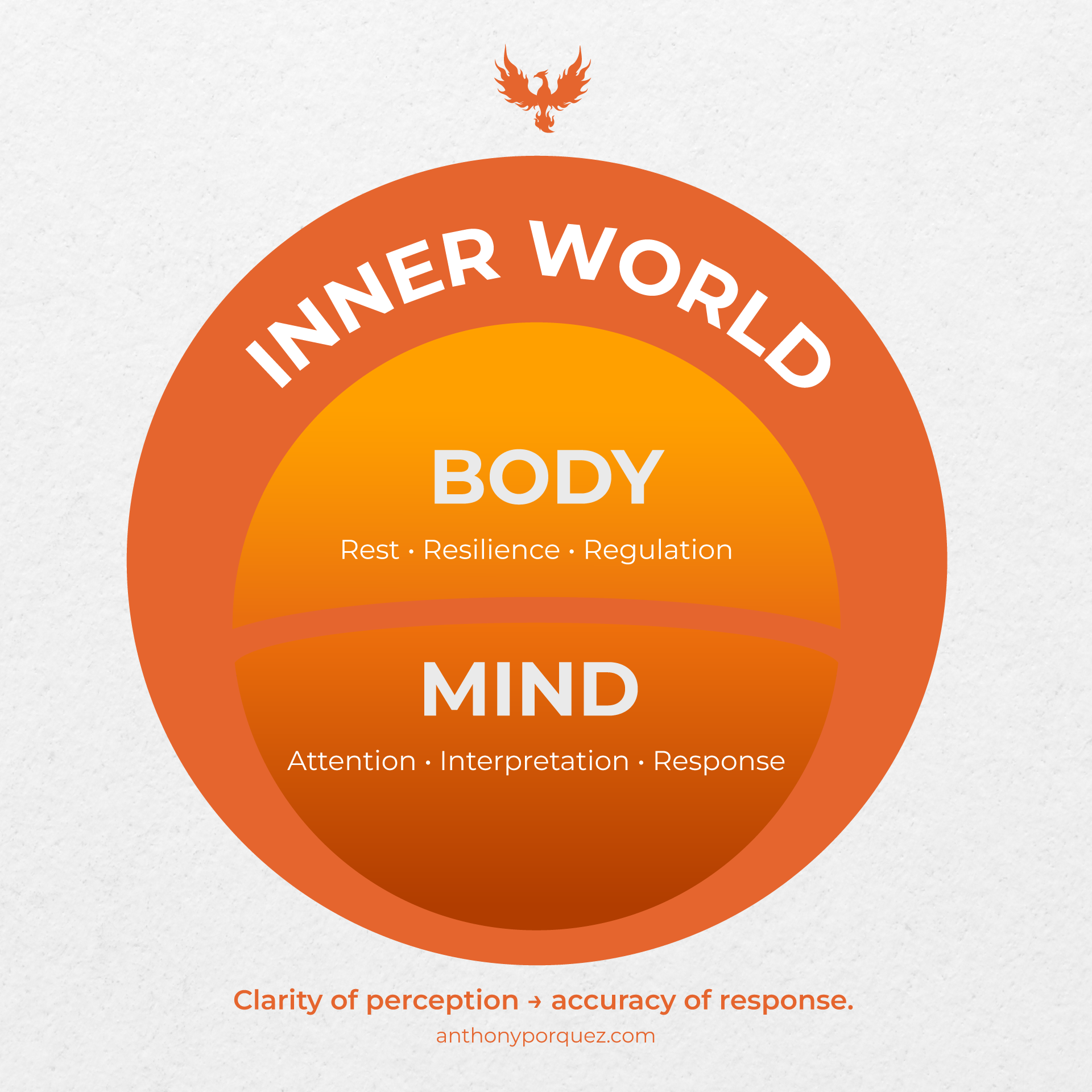
Leak #4 — Air (Mind): Cognitive spillover → short fuse leadership
Here’s the tell:
You close the laptop, but your mind is still in the meeting.
You’re in bed solving tomorrow’s problems at 1:12 a.m.
You’re replaying conversations, checking numbers, pre-running worst-case scenarios.
That’s not high standards. That’s cognitive spillover.
And spillover has a predictable downstream symptom in leadership: short fuse leadership.
You’re not “angry.” You’re operating without buffer—so everything feels like friction.
The fuse gets shorter because the system has less capacity to absorb normal load.
Maintenance standard (install tonight):
Operational closeout (5 minutes):
Write:
tomorrow’s Top 3
park one open loop
Then stop.
This isn’t journaling. It’s closing tabs so your brain stops running work in the background while you’re trying to recover.
SECTION 3: The multiplier — uncertainty increases vigilance load
One more layer in 2026 is simple: uncertainty is higher, and uncertainty increases vigilance.
When vigilance rises, your mind runs hotter in the background. Buffer shrinks. Small problems feel heavier. Recovery gets harder to access—not because you’re weaker, but because the system is consuming more bandwidth just to feel “ready.”
If you want a practical reference that stays grounded and non-alarmist, the Canadian Psychological Association’s guidance on coping with geopolitical crises summarizes the mental load pattern and coping principles clearly:
https://cpa.ca/psychology-works-fact-sheet-coping-with-geopolitical-crises/
That’s why May maintenance matters: when the environment is unstable, systems matter more, not less.
wrap up: “More good days” is a system outcome
Good days aren’t a mood. They’re a system outcome.
Stop proving you can carry it.
Start maintaining the system that carries you.
If May feels heavier, it’s not weakness. It’s maintenance debt.
Turn diagnosis into action
You just identified the four leaks.
Now you need the tool that turns diagnosis into action.
Start the free 3-Day Capacity Audit
In 10–15 minutes a day, you’ll pinpoint your #1 leak (Fire, Air, Water, or Earth) and lock in one maintenance standard this week.